
Weatherford Foundation Repair vs. Replacement: Making the Right Call
Sticking doors, wall cracks above window frames, and a floor that no longer feels level — these are the signs that Parker County clay soil movement has reached your foundation. For Weatherford homeowners facing these symptoms, the most common question is whether foundation repair can fix the problem or whether the foundation needs to be replaced entirely. In this guide, we explain how clay soil drives foundation problems in Weatherford and how to evaluate which path is right for your situation.
Foundation Assessment in Weatherford, TX
We assess concrete foundation conditions honestly. Call Weatherford Concrete Company at (888) 376-0955.
Why Foundation Problems Are Common in Weatherford
Concrete foundation Weatherford homeowners deal with is sitting on soil that does something unusual in most of Texas: it moves. Parker County’s Weatherford soil series — a fine-loamy soil with a Bt horizon of sandy clay loam at 18–35% clay content — undergoes measurable volume changes with moisture. When it swells, it pushes upward against foundation edges. When it contracts during Weatherford’s summer drought (a 10–11 inch annual soil moisture deficit), it pulls away from the foundation underside, creating voids that cause differential settlement.
This cycle — swelling in spring, contracting in summer — repeats every year. When it occurs evenly across the entire foundation footprint, the foundation moves as a unit and the structure above it typically doesn’t notice. When it occurs unevenly — more soil movement under one end of the slab than the other — the foundation tilts slightly, and the structure above it begins to show the classic symptoms: doors that stick in summer when the wetter side swells, cracks in drywall above doorframes, and visible gaps between wall and floor on the settled side.
Types of Foundation Issues in Parker County Homes
Edge lift: The perimeter of the slab lifts relative to the center, caused by moisture (sprinkler systems, downspout discharge, or poor drainage) consistently wetting the soil at the foundation perimeter while the interior remains drier. Common in Weatherford neighborhoods with mature landscaping close to the house.
Center settlement (dome or tent): The center of the slab settles relative to the perimeter, caused by the interior soil drying out more than the perimeter soil. Common in homes without a drip irrigation system maintaining consistent soil moisture under the foundation.
Uniform settlement: The entire foundation settles gradually as the sub-grade soil compresses or erodes. Less common in Parker County than differential settlement, but occurs in areas with poorly compacted original fill.
Lateral movement: Foundation edges shift horizontally rather than vertically, caused by unbalanced soil pressure from one side (sloped lots, retaining soil against one foundation wall). More common in Weatherford’s hillier sections and in the Historic Downtown area where older structures were built on cut slopes.
Practical Scenarios: Repair vs. Replacement
Scenario 1 — Recent construction (under 15 years), differential settlement less than 1 inch: Foundation repair is almost always the right call. Pier systems (pressed piles, helical piers, or drilled piers) can be installed around the perimeter to lift settled sections and stabilize the foundation at its current best level. Combined with a soil moisture management program (drip irrigation maintaining consistent moisture around the perimeter), most young foundations with moderate differential settlement are stabilized successfully without replacement.
Scenario 2 — Older construction (20+ years), widespread cracking through the slab: The assessment depends on whether the cracking is cosmetic (surface-only, at control joints) or structural (through the full slab depth, with vertical offset between sections). Surface cracking at control joints is normal and doesn’t indicate replacement need. Full-depth cracks with section offset — especially in multiple directions — suggest that the foundation has experienced permanent structural damage that pier systems can level but can’t restore to original integrity. Replacement becomes cost-competitive when the cost of comprehensive pier installation approaches the cost of a new slab with correct engineering.
Scenario 3 — Historic Downtown Weatherford home with pier-and-beam foundation: Older Weatherford homes in the Historic Downtown area frequently have pier-and-beam foundations rather than slabs. These foundations have different failure modes (wood rot in the beams, settling piers, inadequate support spacing) and different repair options (concrete underpinning of existing piers, sistering new beams) than slab foundations. Conversion from pier-and-beam to a concrete slab is possible but is a full replacement project.
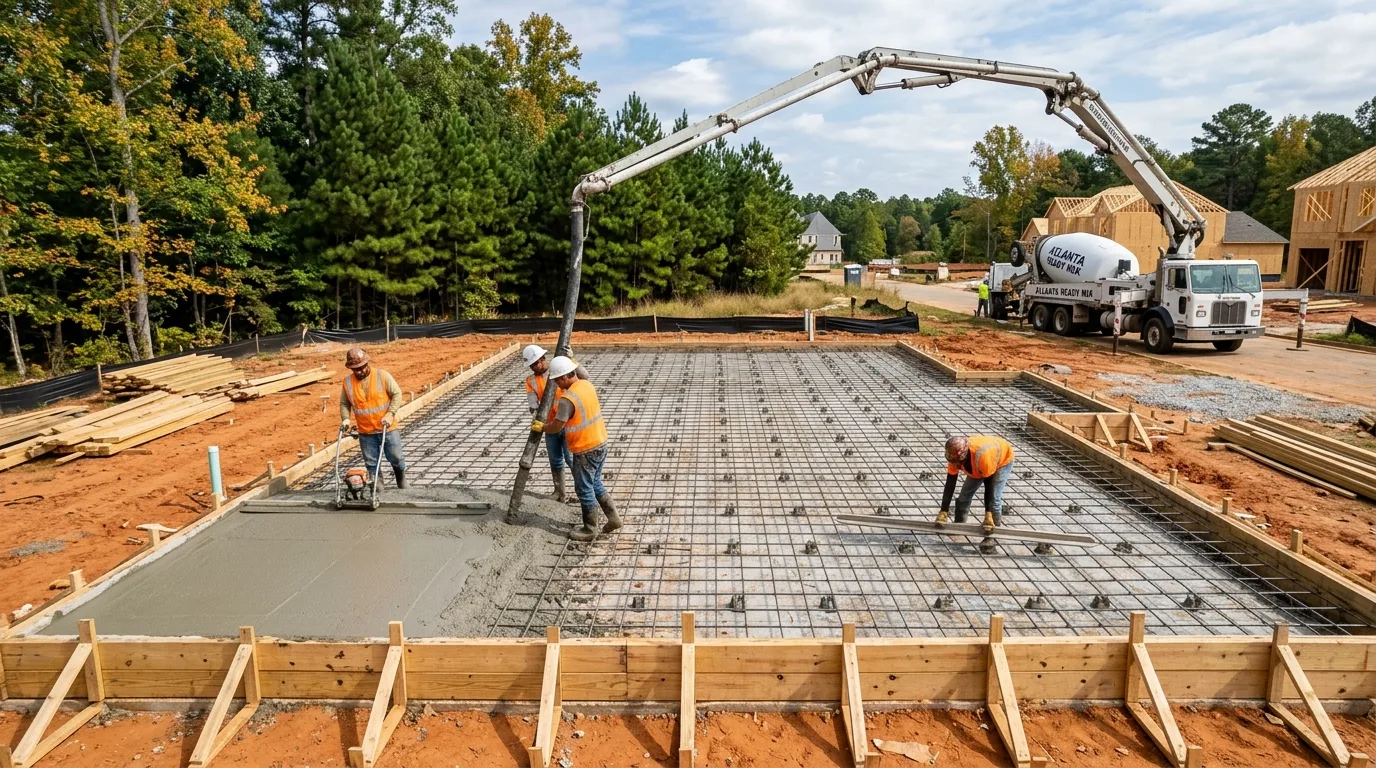
Scenario 4 — New construction on a lot with known drainage problems: When a foundation pour is planned on a Parker County lot with identified drainage issues — concentrated runoff, a history of water ponding, proximity to Lake Weatherford seasonal shoreline — the engineering of the foundation itself should address those drainage conditions rather than just installing a standard slab and hoping. See our concrete foundations service page for how we approach foundation design on challenging lots.
Concrete Foundation Work in Weatherford, TX
New pours and honest assessments. Free estimate — (888) 376-0955.
What Affects the Cost of Foundation Work in Weatherford
New concrete slab foundations in Weatherford typically cost $5–$10 per square foot all-in — a 1,500 square foot home footprint runs $7,500–$15,000 depending on thickness, post-tension vs. conventional design, and site preparation requirements. Foundation pier repair systems run $1,500–$3,500 per pier installed, with most residential repairs requiring 8–20 piers depending on foundation size and damage extent.
The cost comparison between repair and replacement depends on the number of piers needed and the foundation condition. When a Parker County home needs 16+ piers plus additional drainage corrections, a total repair cost of $25,000–$40,000 approaches the cost of a new engineered slab that doesn’t carry the scar tissue of the previous failures. In these cases, a structural engineer’s recommendation is valuable — it quantifies whether repair or replacement provides better long-term value.
City of Weatherford Development Services permits are required for all foundation work. We handle permit applications and inspection scheduling as part of every foundation project.
Frequently Asked Questions
How do I know if my Weatherford foundation needs repair or replacement?
Differential settlement less than 1.5 inches with no full-depth slab cracking is typically within the range where pier systems and drainage correction can stabilize the foundation successfully. Widespread full-depth cracking with section offset greater than 1 inch, foundation age over 30 years with ongoing active movement, or total repair cost approaching replacement cost all point toward replacement as the more cost-effective long-term solution. A structural engineer’s assessment is the most reliable way to make this determination.
What causes foundation problems in Weatherford, TX specifically?
Parker County’s expansive clay soil is the primary driver. The Bt horizon of sandy clay loam swells with seasonal rainfall and contracts 10–11 inches of moisture deficit each summer — creating differential soil movement under foundations that aren’t protected by adequate moisture management and drainage. Poor original drainage design (water collecting against the foundation perimeter), inadequate soil moisture maintenance during drought years, and tree roots extracting moisture near foundation edges all amplify the natural clay cycle.
Do new concrete foundations in Weatherford have warranty protection against clay soil movement?
Most concrete foundation warranties cover material defects and installation quality, not differential settlement caused by soil movement after construction. The best protection against future clay-driven foundation movement is proper drainage design, a consistent perimeter drip irrigation program to maintain uniform soil moisture, and avoiding large trees within 15–20 feet of the foundation that can extract significant soil moisture in summer. We discuss drainage and soil moisture management as part of every new foundation project.
Foundation Work in Weatherford — New Pours and Honest Assessments
Call Weatherford Concrete Company at (888) 376-0955. We'll tell you exactly what we see and what we recommend.
Related: